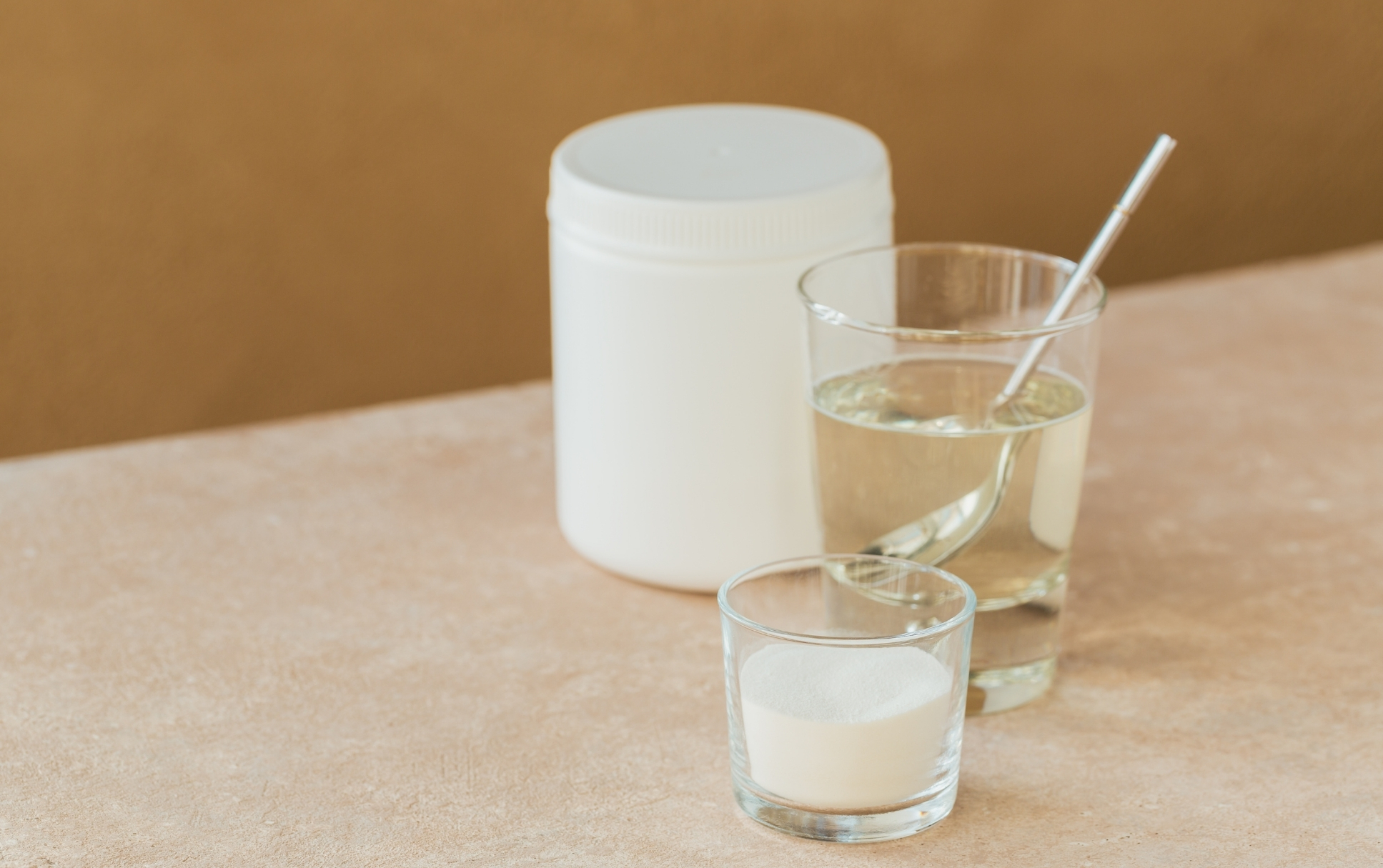

When collagen powder is discussed, it usually refers to hydrolyzed collagen, or collagen peptides. Research shows that after oral intake, free amino acids and small collagen-derived peptides can be detected in the bloodstream [1], [2], [3]. There is no strong evidence that one time of day - morning or evening - is significantly better for absorption in most people. In practice, consistency, an appropriate dose and the form of the product matter more [4].
After hydrolyzed collagen is taken, characteristic peptides can be detected in the bloodstream, including Pro-Hyp and other hydroxyproline-containing peptides. In human studies, concentrations of certain collagen-derived peptides increase during the first 1-2 hours after intake [1], [2], [3]. In practical terms, this means:
Collagen peptides are not broken down exclusively into free amino acids - some can also be absorbed in the form of small peptides [1], [2], [3].
For absorption itself, there is not enough evidence that morning or evening is superior. With daily supplementation, it is more practical to choose a time that makes consistent intake easier [4].
Practical approach:
The timing can be adapted to the daily routine, for example with a morning drink or later in the day. In studies focused on skin outcomes, effects are most often assessed after at least 8 weeks of continuous supplementation [4].
The claim that collagen “is absorbed only on an empty stomach” does not have strong clinical support. There is not enough evidence that taking it without food provides a meaningful advantage over taking it with a meal for most people.
Practical approach:
Taking collagen on an empty stomach is also an option if it is well tolerated, but it is not a requirement for absorption.
For skin, hydrolyzed collagen peptides are most commonly used as part of a consistent daily routine. A meta-analysis of randomized studies found improvements in skin hydration and elasticity, although results varied between products and studies [4].
For connective tissue in the context of rehabilitation or training, one randomized controlled trial used vitamin C-enriched gelatin approximately 1 hour before activity and found an increase in a marker of type I collagen synthesis [5].
Taking collagen or gelatin 30-60 minutes before exercises that load the tendons and ligaments can be viewed as a specific training-related strategy, but the evidence relates to a biomarker and does not confirm superior overall absorption or a clinical outcome [5].
Note: the study used vitamin C-enriched gelatin and measured a marker of collagen synthesis, so its results should not be interpreted as evidence of “faster recovery” or injury treatment [5].
For bone health, the foundation remains adequate intake of protein, vitamin D and calcium, together with appropriate physical activity. Collagen may be an additional component, but it is not a substitute for these fundamental factors [6].
Vitamin C is an essential cofactor in collagen biosynthesis, particularly in the hydroxylation of proline and lysine [7], [8]. This does not mean that vitamin C “increases the absorption of collagen powder”; rather, it is required for normal collagen synthesis and maturation in the body.
Practical approach:
Doses vary across studies. Health Canada’s monograph for hydrolyzed collagen lists a range of approximately 2.5-10 g per day, depending on the intended use of the product [6].
A higher dose is not automatically better. Priority should be given to a clearly labeled product, an appropriate dose and consistent use.
Hydrolyzed collagen can be mixed into water, a smoothie, yogurt or coffee. The choice of beverage should primarily make regular use simple and convenient.
Hydrolyzed collagen is absorbed both as free amino acids and as small peptides, but there is no evidence that there is one “perfect” time of day or that it must be taken on an empty stomach [1], [2], [3]. For most goals, the most important factors are the appropriate form, a realistic dose and consistency. Taking it 30-60 minutes before exercise has a specific physiological rationale in some connective-tissue protocols, but it is not a universal rule [5].
[1] Virgilio N, et al. Absorption of Bioactive Peptides Following Collagen Hydrolysate Intake: A Randomized, Double-Blind Crossover Study in Healthy Individuals. 2024.
https://pmc.ncbi.nlm.nih.gov/articles/PMC11325589/
[2] Lis DM, Baar K. The Impact of Collagen Protein Ingestion on Musculoskeletal Connective Tissue Remodeling: A Narrative Review. 2022.
https://pmc.ncbi.nlm.nih.gov/articles/PMC9086765/
[3] Taga Y, et al. Identification of a Highly Stable Bioactive 3-Hydroxyproline-Containing Tripeptide in Human Blood After Collagen Hydrolysate Ingestion. 2022.
https://pmc.ncbi.nlm.nih.gov/articles/PMC9166765/
[4] Pu SY, et al. Effects of Oral Collagen for Skin Anti-Aging: A Systematic Review and Meta-Analysis. 2023.
https://pmc.ncbi.nlm.nih.gov/articles/PMC10180699/
[5] Shaw G, et al. Vitamin C-Enriched Gelatin Supplementation Before Intermittent Activity Augments Collagen Synthesis. 2017.
https://pmc.ncbi.nlm.nih.gov/articles/PMC5183725/
[6] Health Canada. Hydrolyzed Collagen - Natural Health Product Monograph. Accessed 2026.
https://webprod.hc-sc.gc.ca/nhpid-bdipsn/atReq?atid=hydrolized.collagen&lang=eng
[7] Abdullah M, Jamil RT, Attia FN. Vitamin C (Ascorbic Acid). StatPearls, NCBI Bookshelf. 2023.
https://www.ncbi.nlm.nih.gov/books/NBK499877/
[8] Pinnell SR. Regulation of Collagen Biosynthesis by Ascorbic Acid: A Review. 1985.
https://pmc.ncbi.nlm.nih.gov/articles/PMC2589959/
Health Disclaimer: This content is for educational and informational purposes only and is not a substitute for professional medical advice, diagnosis, or treatment. Always consult a qualified healthcare professional before starting or changing any supplement, especially if you are pregnant, breastfeeding, have a medical condition, or take medication.