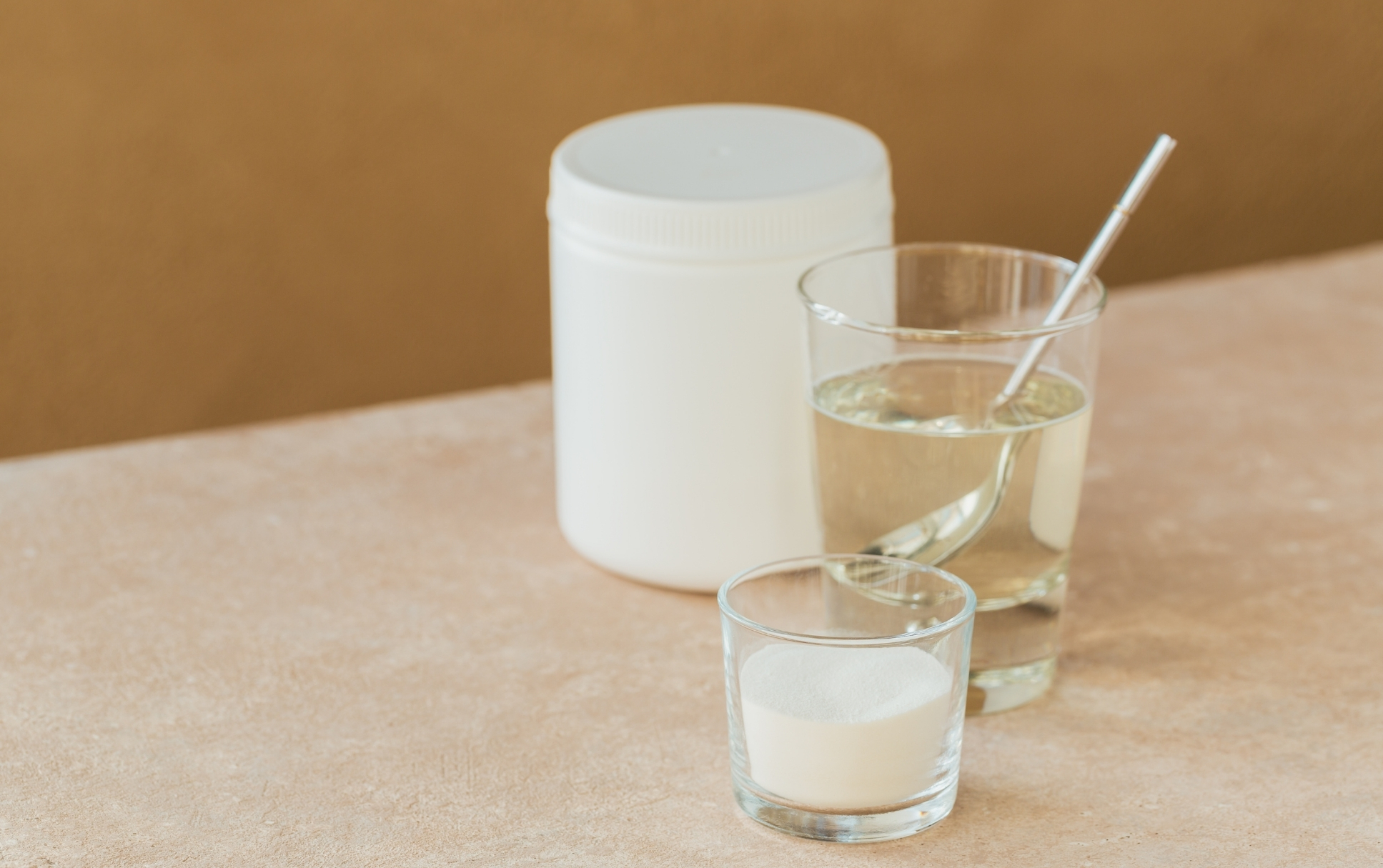

Collagen powder, most often sold as “hydrolyzed collagen” or “collagen peptides,” is one of the most popular supplements for skin and joints, but it sits at the intersection of genuine scientific evidence and aggressive marketing. In short: it is not a complete scam, but it is not a miracle either. Effects are moderate on average, depend on the goal, product, dose, and duration, and the quality of evidence is not the same for every claim [1], [2].
Most collagen powder is hydrolyzed, meaning the protein has been broken down into smaller peptides. In theory, some of these peptides and amino acids may contribute to the body’s own collagen synthesis and influence skin or cartilage cells through signaling mechanisms [3]. This is biologically plausible, but plausibility is not the same as a clinically meaningful result.
For skin, there are multiple randomized studies and meta-analyses. One systematic review and meta-analysis of 26 randomized controlled trials found that hydrolyzed collagen supplementation significantly improved skin hydration and elasticity compared with placebo [1]. This suggests that an effect may exist, but:
In addition, a newer analysis found an interesting pattern: in the subgroup of studies without industry funding, effects on hydration, elasticity, and wrinkles were not evident, whereas industry-funded studies showed statistically significant effects [4]. This does not prove that collagen “does not work,” but it is a strong signal that marketing and conflicts of interest may make the evidence look more favorable.
For joints, meta-analyses suggest reductions in pain and improvements in functional scores in knee osteoarthritis after oral collagen peptides, while authors also note that better-designed trials are needed because of potential bias [5]. Another meta-analysis concluded that oral collagen may improve OA symptoms [2]. In physically active people, a well-known 24-week randomized controlled trial reported improvement in activity-related joint pain with collagen hydrolysate [6].
Bottom line for joints: some people may experience moderate improvements in pain or function, but collagen is not a substitute for exercise, weight management, physical therapy, or an established treatment plan [2], [5].
Randomized trials in postmenopausal women with reduced BMD have associated specific collagen peptides with improvements in BMD and favorable changes in markers of bone metabolism compared with placebo [7]. These findings are promising, but the key point is that the product studied was specific, so the results do not automatically apply to every collagen product on the market.
Unrealistic expectations and use for too short a period
Skin studies often last 8-12+ weeks, while joint studies may last even longer [1], [6]. If someone expects a “lifting effect” in 10 days, disappointment is likely.
Collagen powder is a more reasonable choice when:
The goal is a moderate improvement in skin hydration or elasticity, or joint pain or function, with willingness to use the product consistently for 2-3 months [1], [6].
Red flags:
Claims such as “rebuilds cartilage,” “erases wrinkles,” or “treats arthritis” sound like drug claims [8].
In studies, collagen peptides are generally well tolerated, and meta-analyses in OA often do not find a higher rate of adverse events than placebo [5]. Mild gastrointestinal symptoms may still occur, and people with allergies, for example fish allergy, should choose the collagen source carefully.
Collagen powder is not just a marketing trick because clinical data suggest potential benefits for skin, joints, and, in some populations, bones [1], [2], [7]. However, marketing often exaggerates the effect, and the quality and independence of the evidence are not always ideal, particularly when funding is considered [4]. The most accurate summary is that collagen may provide a moderate, gradual benefit for some people, but it is not magic.
[1] Pu SY, et al. Effects of Oral Collagen for Skin Anti-Aging: A Systematic Review and Meta-Analysis 2023.
https://pmc.ncbi.nlm.nih.gov/articles/PMC10180699/
[2] Simental-Mendía M, et al. Effect of Collagen Supplementation on Knee Osteoarthritis: A Systematic Review and Meta-Analysis 2025.
https://pubmed.ncbi.nlm.nih.gov/39212129/
[3] Amirrah IN, et al. A Comprehensive Review on Collagen Type I Development of Biomaterials for Tissue Engineering: From Biosynthesis to Bioscaffold 2022.
https://pmc.ncbi.nlm.nih.gov/articles/PMC9496548/
[4] Myung SK, Park Y. Effects of Collagen Supplements on Skin Aging: A Systematic Review and Meta-Analysis of Randomized Controlled Trials 2025.
https://pubmed.ncbi.nlm.nih.gov/40324552/
[5] Lin CR, et al. Analgesic Efficacy of Collagen Peptide in Knee Osteoarthritis: A Meta-Analysis of Randomized Controlled Trials 2023.
https://pmc.ncbi.nlm.nih.gov/articles/PMC10505327/
[6] Clark KL, et al. 24-Week Study on the Use of Collagen Hydrolysate as a Dietary Supplement in Athletes With Activity-Related Joint Pain 2008.
https://pubmed.ncbi.nlm.nih.gov/18416885/
[7] König D, et al. Specific Collagen Peptides Improve Bone Mineral Density and Bone Markers in Postmenopausal Women: A Randomized Controlled Study 2018.
https://pmc.ncbi.nlm.nih.gov/articles/PMC5793325/
[8] U.S. Food and Drug Administration (FDA). FDA 101: Dietary Supplements Accessed 2026.
https://www.fda.gov/consumers/consumer-updates/fda-101-dietary-supplements
[9] EFSA Panel on Dietetic Products, Nutrition and Allergies (NDA). Scientific Opinion on the Substantiation of a Health Claim Related to VeriSol®P and a Change in Skin Elasticity Leading to an Improvement in Skin Function 2013.
https://efsa.onlinelibrary.wiley.com/doi/10.2903/j.efsa.2013.3257
[10] U.S. Food and Drug Administration (FDA). Questions and Answers on Dietary Supplements Accessed 2026.
Health Disclaimer: This content is for educational and informational purposes only and is not a substitute for professional medical advice, diagnosis, or treatment. Always consult a qualified healthcare professional before starting or changing any supplement, especially if you are pregnant, breastfeeding, have a medical condition, or take medication.