
Collagen is the most abundant protein in connective tissue and one of the key structural components of skin, bones, tendons, and cartilage. Supplements most commonly contain type I, II, or III collagen, but the “best” type depends on what the goal is: supporting the skin, joints (cartilage), or bones [1], [2].
Important: Collagen supplements are not medications, and claims on product labels should be distinguished from the results of clinical research. In the United States, the U.S. Food and Drug Administration does not approve dietary supplements as drugs before they reach the market, so a marketing claim by itself is not evidence of clinical efficacy [13].
In practice: a label stating “type I & III” is most often associated with skin support and potentially bone support, while “type II” more often refers to joint cartilage.
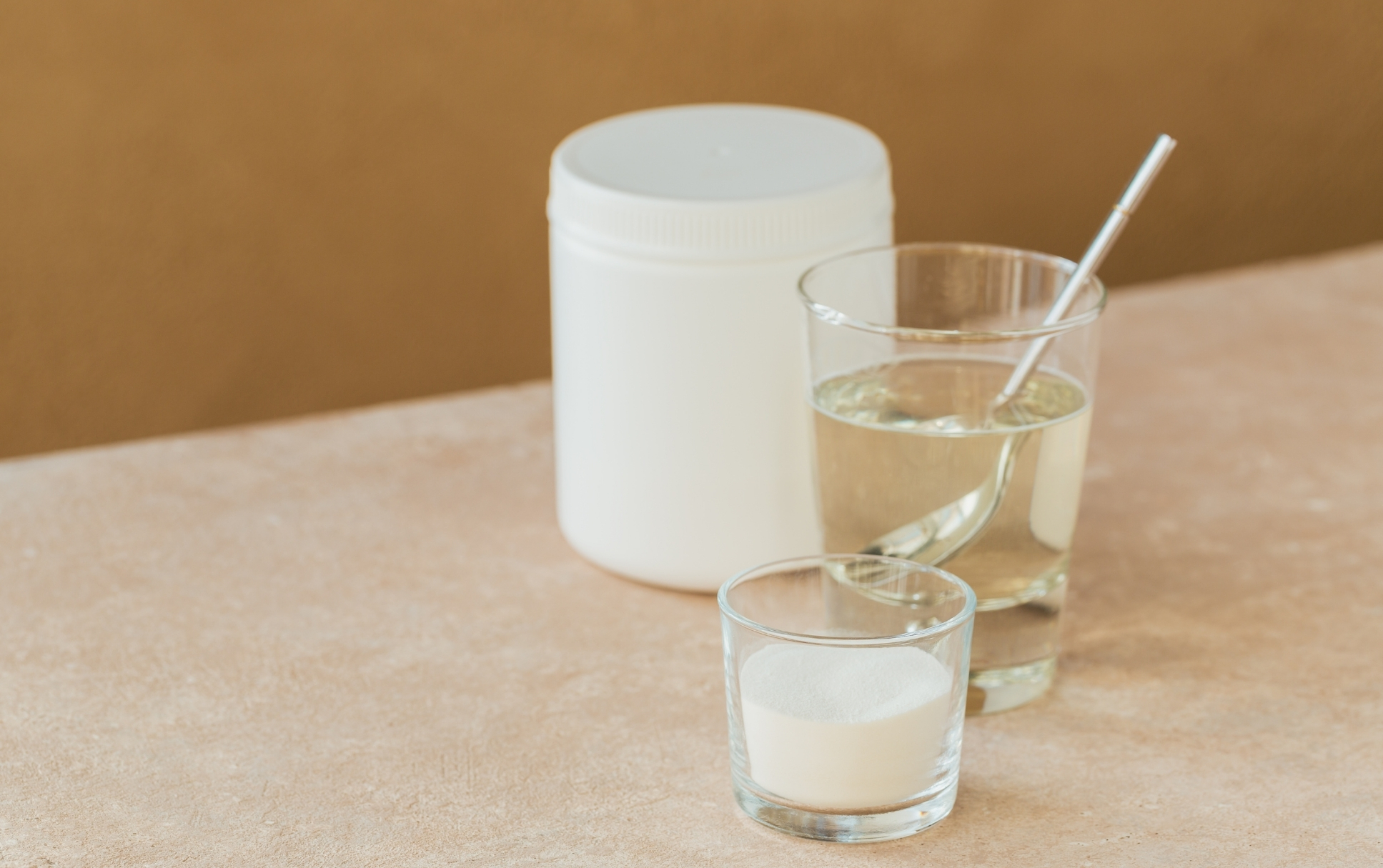
In practice, two forms are encountered most often:
The largest amount of clinical evidence for skin is available for hydrolyzed collagen peptides, most often from sources rich in type I collagen, frequently with type III as well. Systematic reviews and meta-analyses of clinical trials suggest improvements in parameters such as skin hydration and elasticity compared with placebo, although results vary among studies [3], [5].
A frequently cited randomized, placebo-controlled study found improved skin elasticity in women taking 2.5 g or 5 g of collagen hydrolysate daily for 8 weeks compared with placebo [6]. More recent randomized studies have also assessed biometric skin parameters and reported improvements in certain measurements, although study quality and design vary [10].
Realistic expectations: effects are usually moderate and require consistency, most often 8-12+ weeks in studies [5], [6].
There are two approaches here, supported by different types of evidence:
Randomized studies report improvements in certain outcomes related to joint function and symptoms at doses of about 40 mg/day, with generally good tolerability [8], [9].
This option makes the most sense when the main goal is joint cartilage, mobility, or symptoms and the product clearly states undenatured type II with a dose in milligrams rather than grams [8], [9].
Randomized controlled trials and meta-analyses in osteoarthritis, a degenerative joint disease, suggest reductions in pain and improvements in functional scores such as WOMAC compared with control, while also noting substantial heterogeneity among studies in products, doses, and treatment duration [7], [11]. Studies in physically active people with activity-related joint pain have also reported improvement during 24 weeks of supplementation [12].
People taking pain medications, such as NSAIDs (nonsteroidal anti-inflammatory drugs including ibuprofen or naproxen), should not change treatment on their own; a supplement is not a substitute for a treatment plan [13].
Bones are rich in type I collagen, so specific collagen peptides, mainly type I, have been studied as dietary supplements, especially in people with lower bone mineral density.
A randomized controlled trial in postmenopausal women with reduced BMD found that supplementation with specific collagen peptides may increase BMD and favorably affect markers of bone metabolism compared with placebo [14]. Earlier studies have also examined biochemical markers of bone remodeling during collagen-hydrolysate supplementation [15].
Doses vary among studies, but hydrolyzed collagen is commonly used in gram-level doses, for example 2.5-10 g/day, whereas undenatured type II is typically used in doses of tens of milligrams [6], [8]. As a practical reference, Health Canada lists dosing ranges for hydrolyzed collagen, including approximately 2.6-10 g/day for certain uses, and provides cautionary notes for specific populations [15].
Collagen is generally well tolerated in studies; meta-analyses in osteoarthritis report that collagen derivatives did not increase the risk of adverse events compared with control within the included studies [11]. Mild gastrointestinal symptoms such as bloating or nausea may still occur in some people.
Caution:
Skin (elasticity/hydration): most often hydrolyzed collagen peptides, usually type I and often with type III, taken consistently for 8-12+ weeks [5], [6].
[1] Nezwek TA, et al. Physiology, Connective Tissue. StatPearls (NCBI Bookshelf) 2024.
https://www.ncbi.nlm.nih.gov/books/NBK542226/
[2] Amirrah IN, et al. A Comprehensive Review on Collagen Type I Development of Biomaterials for Tissue Engineering: From Biosynthesis to Bioscaffold 2022.
https://pmc.ncbi.nlm.nih.gov/articles/PMC9496548/
[3] Pu SY, et al. Effects of Oral Collagen for Skin Anti-Aging: A Systematic Review and Meta-Analysis 2023.
https://pmc.ncbi.nlm.nih.gov/articles/PMC10180699/
[4] Chang LR, et al. Anatomy, Cartilage. StatPearls (NCBI Bookshelf) 2024.
https://www.ncbi.nlm.nih.gov/books/NBK532964/
[5] de Miranda RB, Weimer P, Rossi RC. Effects of Hydrolyzed Collagen Supplementation on Skin Aging: A Systematic Review and Meta-Analysis 2021.
https://onlinelibrary.wiley.com/doi/10.1111/ijd.15518
[6] Proksch E, et al. Oral Supplementation of Specific Collagen Peptides Has Beneficial Effects on Human Skin Physiology: A Double-Blind, Placebo-Controlled Study 2014.
https://pubmed.ncbi.nlm.nih.gov/23949208/
[7] García-Coronado JM, et al. Effect of Collagen Supplementation on Osteoarthritis Symptoms: A Meta-Analysis of Randomized Placebo-Controlled Trials 2019.
https://pubmed.ncbi.nlm.nih.gov/30368550/
[8] Lugo JP, et al. Undenatured Type II Collagen (UC-II®) for Joint Support: A Randomized, Double-Blind, Placebo-Controlled Study in Healthy Volunteers 2013.
https://pmc.ncbi.nlm.nih.gov/articles/PMC4015808/
[9] Gupta A, Maffulli N. Undenatured Type II Collagen for Knee Osteoarthritis 2025.
https://pmc.ncbi.nlm.nih.gov/articles/PMC12010644/
[10] Demir-Dora D, et al. The Efficacy and Safety of CollaSel Pro® Hydrolyzed Collagen Peptide Supplementation Without Addons in Improving Skin Health in Adult Females 2024.
https://pmc.ncbi.nlm.nih.gov/articles/PMC11432272/
[11] Lin CR, et al. Analgesic Efficacy of Collagen Peptide in Knee Osteoarthritis: A Meta-Analysis of Randomized Controlled Trials 2023.
https://pmc.ncbi.nlm.nih.gov/articles/PMC10505327/
[12] Clark KL, et al. 24-Week Study on the Use of Collagen Hydrolysate as a Dietary Supplement in Athletes With Activity-Related Joint Pain 2008.
https://pubmed.ncbi.nlm.nih.gov/18416885/
[13] U.S. Food and Drug Administration (FDA). FDA 101: Dietary Supplements Accessed 2026.
https://www.fda.gov/consumers/consumer-updates/fda-101-dietary-supplements
[14] König D, et al. Specific Collagen Peptides Improve Bone Mineral Density and Bone Markers in Postmenopausal Women: A Randomized Controlled Study 2018.
https://pmc.ncbi.nlm.nih.gov/articles/PMC5793325/
[15] Health Canada. Hydrolyzed Collagen: Natural Health Product Monograph 2024.
https://webprod.hc-sc.gc.ca/nhpid-bdipsn/dbImages/mono_hydrolyzed-collagen_english.pdf
Health Disclaimer: This content is for educational and informational purposes only and is not a substitute for professional medical advice, diagnosis, or treatment. Always consult a qualified healthcare professional before starting or changing any supplement, especially if you are pregnant, breastfeeding, have a medical condition, or take medication.