Collagen and gelatin are closely related because gelatin is derived from collagen, but they differ in degree of processing, structure, and behavior in water, and therefore in how they are used. Gelatin is primarily a functional gelling ingredient in food and pharmaceutical applications, while collagen powder is usually sold as hydrolyzed collagen or collagen peptides for beverages and supplements [1], [2].
Collagen is the most abundant protein in the human body and a major structural framework of connective tissue; type I is particularly important in the skin and bones [1], [2].
Gelatin is produced by partial hydrolysis of collagen derived from animal skin, connective tissue, and bones. Scientific and technical references describe gelatin as a product of partial collagen hydrolysis, with a broad range of molecular weights [2], [3].
In practice:
The difference can be viewed as three stages of processing:
Native collagen - a solid triple-helix structure that is poorly soluble [1].
Gelatin - produced by partial hydrolysis or denaturation of collagen, creating a mixture of larger protein fragments that can interact and form a gel [2], [3].
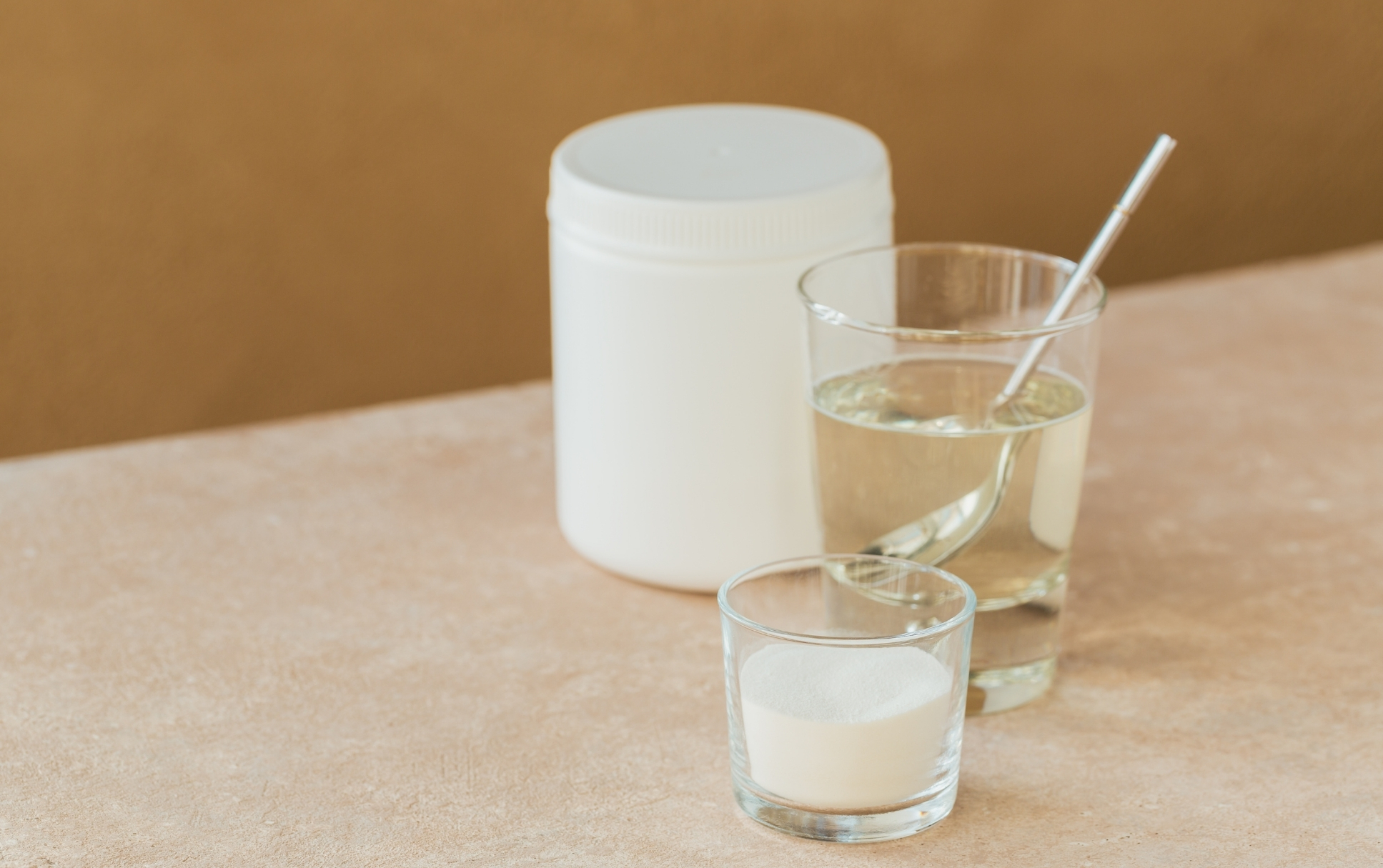
Hydrolyzed collagen (collagen peptides) - produced by further, often enzymatic, hydrolysis and consists of lower-molecular-weight peptides that are much more soluble and usually do not form a firm gel [4], [5].
In short: gelatin is used when texture and gelling are the goal, while collagen peptides are more practical for adding to beverages without a “jelly effect.”
They are similar because they come from the same “parent” protein, collagen, and have similar amino-acid profiles, but there is one important point:
For that reason, gelatin, and often collagen peptides as well, should not be viewed as the main protein source in the diet, but rather as an addition [6].
The following terms often appear on labels:
Technically, hydrolyzed collagen/collagen peptides are further broken-down products with smaller fragments than gelatin, which gives them different solubility and less tendency to gel [4], [5]. Marketing sometimes calls all of these products simply “collagen,” even though they are different forms.
It depends on the goal:
For cooking/texture (gelling):
For a practical addition to beverages without gelling:
For potential benefits (skin/joints):
[1] Nezwek TA, et al. Physiology, Connective Tissue. StatPearls (NCBI Bookshelf) 2024.
https://www.ncbi.nlm.nih.gov/books/NBK542226/
[2] Amirrah IN, et al. A Comprehensive Review on Collagen Type I Development of Biomaterials for Tissue Engineering: From Biosynthesis to Bioscaffold 2022.
https://pmc.ncbi.nlm.nih.gov/articles/PMC9496548/
[3] Yang XR, et al. Preparation and Characterization of Gelatin and Antioxidant Peptides From Gelatin Hydrolysate of Skipjack Tuna Bone Stimulated by In Vitro Gastrointestinal Digestion 2019.
https://pmc.ncbi.nlm.nih.gov/articles/PMC6410064/
[4] León-López A, et al. Hydrolyzed Collagen—Sources and Applications 2019.
https://pmc.ncbi.nlm.nih.gov/articles/PMC6891674/
[5] Al Hajj W, et al. Hydrolyzed Collagen: Exploring Its Applications in the Food and Beverage Industries and Assessing Its Impact on Human Health—A Comprehensive Review 2024.
https://pmc.ncbi.nlm.nih.gov/articles/PMC11381813/
[6] Calixto S, Ganzherli N, Gulyaev S, Figueroa-Gerstenmaier S. Gelatin as a Photosensitive Material 2018.
https://pmc.ncbi.nlm.nih.gov/articles/PMC6222838/
Health Disclaimer: This content is for educational and informational purposes only and is not a substitute for professional medical advice, diagnosis, or treatment. Always consult a qualified healthcare professional before starting or changing any supplement, especially if you are pregnant, breastfeeding, have a medical condition, or take medication.