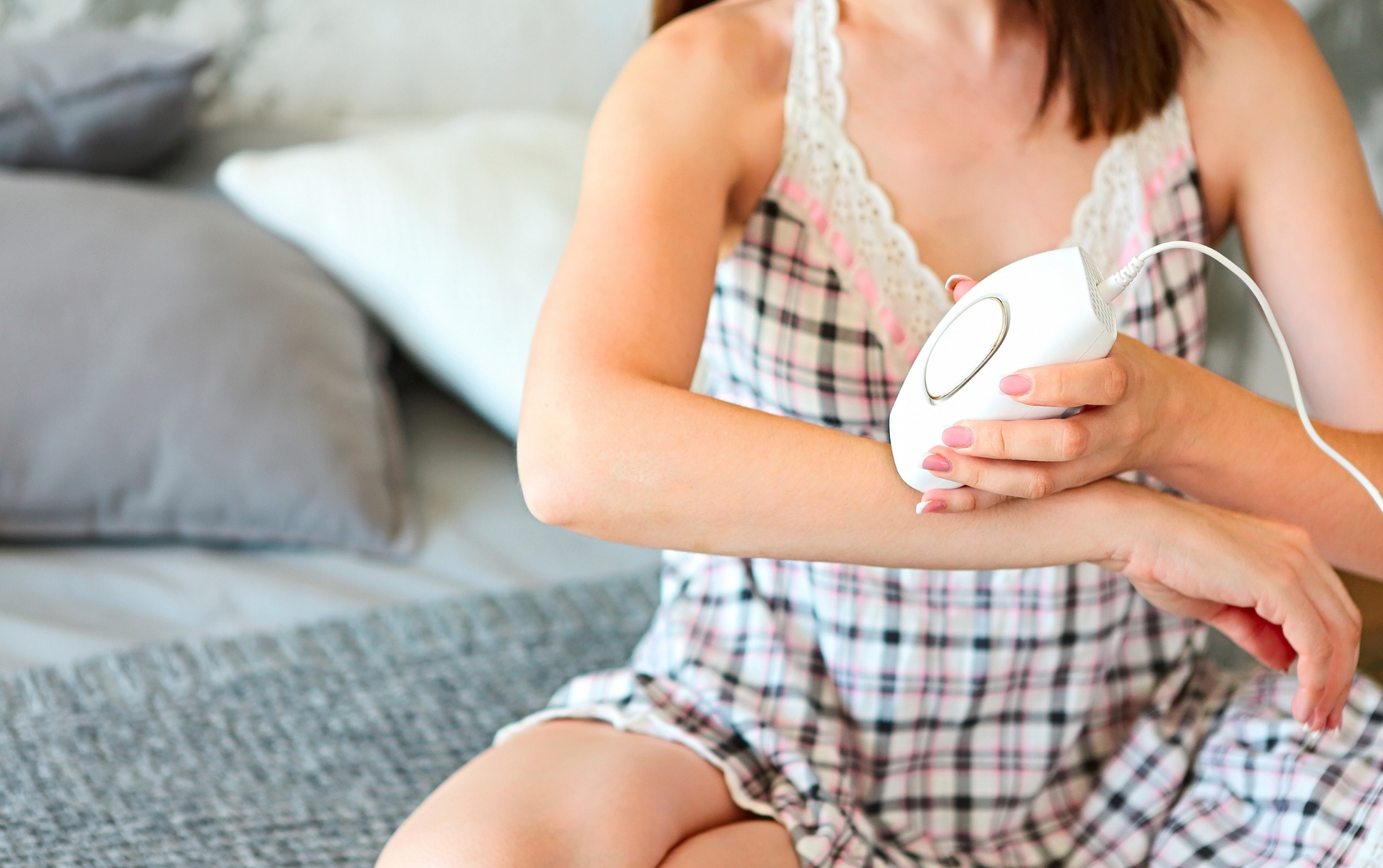
At-home IPL (intense pulsed light) devices can significantly reduce unwanted hair growth, but results do not depend only on the price or power of the device. The most important factors are that the technology matches the combination of skin tone and hair color, that the device has appropriate safety features, and that it is used exactly according to the manufacturer’s instructions.
IPL is not the same as laser. IPL devices emit a broad spectrum of light, while a laser uses a specific wavelength. Light energy is absorbed by pigment, or melanin, and converted into heat that acts on structures within the hair follicle. This is why IPL works best when there is sufficient contrast between the pigment in the hair and the skin. [1][2]
Before purchasing, check which Fitzpatrick skin phototypes the specific device is designed for. The Fitzpatrick classification includes six skin phototypes, ranging from very fair skin that burns easily to very dark skin with a high melanin content.
This is especially important with IPL because melanin is present in both the hair and the epidermis. The goal is for enough energy to be absorbed by the pigment in the hair without the surrounding skin receiving excessive heat.
In practice:
Regulatory documentation shows that supported skin phototypes can differ even among devices in the same category: some models are intended for phototypes I-IV, while others are intended for I-V. Therefore, the label “IPL” alone does not indicate who can safely use the device. [4][5]
Important: skin phototype is not assessed only by how light or dark the skin appears. Its natural response to sun exposure also matters, and recently tanned skin may behave differently from its natural color.
IPL relies on melanin as its target. Dark brown and black hairs are therefore generally the best candidates, particularly when they contrast with lighter skin.
As the amount of pigment in the hair decreases, less light energy can be effectively absorbed by the target structure. Very light, white and gray hairs therefore generally respond poorly to IPL.
Before purchasing, check the official skin-tone and hair-color compatibility chart for the specific device rather than relying only on general claims such as “for all skin types.” [1][2]
Not necessarily.
IPL output is often expressed as energy density, or fluence, in J/cm², but a higher J/cm² value alone does not prove that a device is better.
The effect depends on a combination of several parameters:
Higher energy can increase the thermal effect, but also the risk of adverse reactions. Clinical data show that darker skin pigmentation and higher fluence are associated with a greater risk of reactions such as redness, blisters, crusting and pigment changes. [6]
The goal is therefore not to use the highest possible setting, but the highest setting that is safe and recommended for the specific skin phototype according to the device instructions.
Models with multiple intensity levels and a system that helps select the appropriate energy level have an advantage.
A good at-home IPL device should not be chosen only by the number of flashes or the promised percentage of hair reduction.
Particularly useful features include:
Skin contact sensor
Prevents a flash from being emitted when the applicator is not properly positioned against the skin. This type of system is also found in certain regulator-cleared at-home IPL devices.
Skin tone sensor
Can help the device assess whether the treatment area is suitable for a light pulse, or recommend or automatically adjust the intensity depending on the design of the model.
Multiple energy levels
Allow adjustment for different body areas and individual skin tolerance.
Cooling system
May improve comfort during treatment and reduce the sensation of heat, but cooling cannot make an unsuitable intensity or an unsuitable skin phototype safe.
Clearly defined contraindications and instructions
A reliable device should clearly state supported skin phototypes, permitted body areas, restrictions, the skin-test procedure and the recommended treatment schedule. [2][4]
Be especially cautious with inexpensive devices of unknown origin that are marketed with major claims such as “permanent hair removal,” “100% safe” or “professional laser” without clear technical documentation.
In the U.S. market, some at-home IPL devices have FDA 510(k) clearance as light-based devices for home use intended to reduce unwanted hair. When a manufacturer refers to FDA status, it is useful to verify the exact model and 510(k) number rather than accepting the label “FDA registered” as proof that the specific device has been evaluated.
Regulatory documentation also shows that modern devices may include contact sensors, defined skin phototypes, specified treatment areas and specific light-energy parameters. [4]
That depends on the areas you plan to treat.
A larger treatment window is more practical for:
A smaller or precision attachment may be more practical for:
Do not assume that every IPL device can be used on every body area. Documentation for individual devices specifies permitted treatment areas, and restrictions may differ between models. [4]
IPL should not be considered only in relation to natural skin phototype. Current pigmentation also matters.
After intense sun exposure or tanning, the skin contains more melanin. This increases the possibility that more light energy will be absorbed by the epidermis instead of selectively in the hair area.
Experts therefore recommend avoiding intense sun exposure around IPL treatments and strictly following the instructions for the specific device. Treating tanned, irritated or damaged skin may increase the risk of adverse reactions. [1][5][6]
Before first use, perform a patch test according to the manufacturer’s instructions, especially when using the device for the first time or moving to a higher intensity.
At-home IPL is not a one-time treatment that permanently removes every hair.
Hair passes through different stages of the growth cycle, which is why a series of repeated treatments is required and many users later need occasional maintenance treatments.
Systematic reviews of studies on at-home light-based devices show that IPL can significantly reduce hair counts, although results vary among devices, protocols and users. Available data also indicate that certain at-home IPL devices can provide longer-lasting hair reduction with correct and consistent use. [2][3]
The more accurate term is therefore long-term reduction of hair regrowth, rather than a promise that every hair will disappear permanently.
Before purchasing, check:
The most expensive, most powerful device or the one with the highest number of flashes is not automatically the best choice. The best choice is one that is proven to be compatible with your skin phototype and hair, has good safety controls, and can be used consistently according to a validated protocol. [2][4][5]
IPL can be an effective way to achieve long-term hair-growth reduction at home, but the relationship between skin color, hair pigment and device energy determines both effectiveness and safety.
For very dark skin, unusual pigmentation, active skin problems or uncertainty about device compatibility, it is safer to seek professional assessment before experimenting with intensity settings.
In practice, IPL works best on light skin with dark hair.
[1] DermNet. Intense pulsed light therapy (IPL, flashlamp). 2005.
https://dermnetnz.org/topics/intense-pulsed-light-therapy
[2] PubMed, U.S. National Library of Medicine. Light-based home-use devices for hair removal: Why do they work and how effective they are?. 2019.
https://pubmed.ncbi.nlm.nih.gov/30681170/
[3] PubMed, U.S. National Library of Medicine. A systematic review of light-based home-use devices for hair removal and considerations on human safety. 2012.
https://pubmed.ncbi.nlm.nih.gov/22126235/
[4] U.S. Food and Drug Administration (FDA). 510(k) Summary K251000 - Hand-held Hair Removal Device. 2025.
https://www.accessdata.fda.gov/cdrh_docs/pdf25/K251000.pdf
[5] PubMed, U.S. National Library of Medicine. Laser and Light Treatments for Hair Reduction in Fitzpatrick Skin Types IV-VI: A Comprehensive Review of the Literature. 2018.
https://pubmed.ncbi.nlm.nih.gov/28791605/
[6] PubMed, U.S. National Library of Medicine. Side effects from intense pulsed light: Importance of skin pigmentation, fluence level and ultraviolet radiation - A randomized controlled trial. 2017.
https://pubmed.ncbi.nlm.nih.gov/27474536/
Disclaimer: This content is for educational and informational purposes only and is not a substitute for professional medical or dermatological advice, diagnosis, or treatment. Always consult a qualified healthcare professional or dermatologist if you have a medical condition, persistent skin or scalp concerns, or are unsure whether a product, ingredient, or treatment is appropriate for you.